

In Canada, hype spreads through genetics far more than through labels, and the brands that win are rarely the ones putting the famous name on the package.
Every few months a strain name takes over the conversation. It shows up in drop announcements, budtender recommendations and the comment sections of every cannabis account in the country. The question marketers rarely get a straight answer to is simple: when a strain goes viral, who actually captures the sales?
We looked at two and a half years of Ontario Cannabis Store wholesale data and a month of shelf data from more than 1,900 stores across Canada to find out.
How we defined “viral”
Sales growth alone cannot define a viral strain, because then “does hype sell?” answers itself. Social buzz alone tells you about attention, not purchases. So we used a supply-side signal: a name is viral when unrelated producers start adopting it.
A name can travel in two ways:
- On the label. The strain name appears in the product name on the shelf.
- In the genetics. The product carries a different name, but the hyped strain is listed as a parent in its lineage.
We tracked names that dominated North American conversation over the past three years (Lemon Cherry Gelato, Grape Gas, Zushi, Gary Payton, Permanent Marker, Jealousy, Kush Mints, Runtz and the wider Gelato family) against a few evergreens (Pink Kush, GMO, Wedding Cake). For each one we counted how many brands carried it and measured its share of Ontario Cannabis Store wholesale dollars, comparing the same March to August window in 2024, 2025 and 2026.
Finding 1: The name stays put, the genetics travel
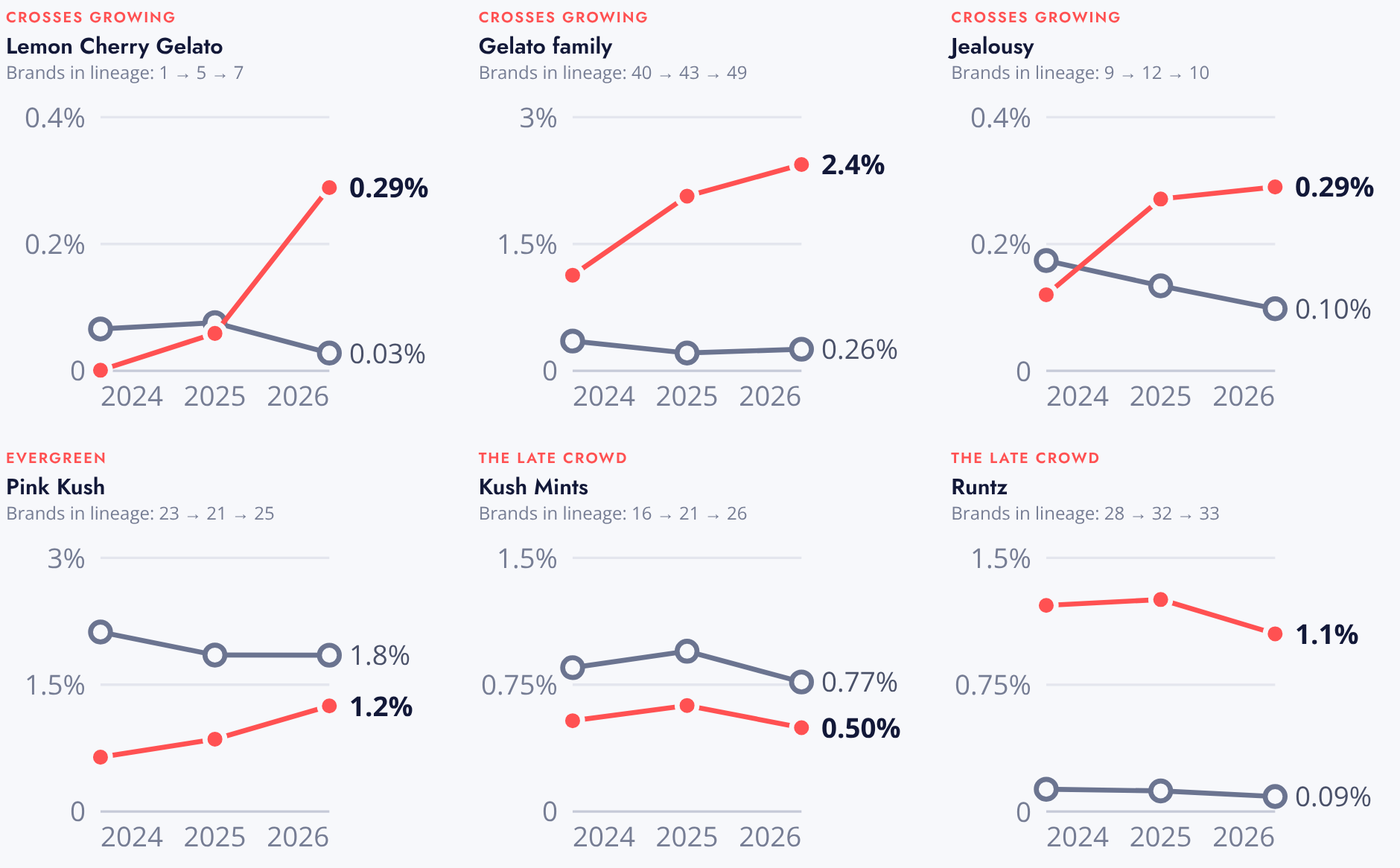
For almost every name we tracked, the share of sales sold under the name shrank over two years, while the share sold through crosses grew.
The famous name lost share while crosses bred from it gained, except where the crowd arrived late
Share of Ontario Cannabis Store wholesale sales, March to August of each year. Each panel has its own scale.
Show the data as a table
| Name | Sold as | 2024 | 2025 | 2026 |
|---|---|---|---|---|
| Lemon Cherry Gelato | On the label | 0.07% | 0.08% | 0.03% |
| Lemon Cherry Gelato | Through lineage | <0.01% | 0.06% | 0.29% |
| Gelato family | On the label | 0.35% | 0.21% | 0.26% |
| Gelato family | Through lineage | 1.1% | 2.1% | 2.4% |
| Jealousy | On the label | 0.17% | 0.13% | 0.10% |
| Jealousy | Through lineage | 0.12% | 0.27% | 0.29% |
| Pink Kush | On the label | 2.1% | 1.9% | 1.8% |
| Pink Kush | Through lineage | 0.64% | 0.86% | 1.2% |
| Kush Mints | On the label | 0.85% | 0.95% | 0.77% |
| Kush Mints | Through lineage | 0.54% | 0.63% | 0.50% |
| Runtz | On the label | 0.13% | 0.12% | 0.09% |
| Runtz | Through lineage | 1.2% | 1.3% | 1.1% |
Lemon Cherry Gelato is the clearest example. Only three brands sell it under that name in Ontario, and together they hold less than half the share they had two years ago. Meanwhile seven brands now sell crosses with Lemon Cherry Gelato in the lineage, and that group went from essentially zero to roughly five times its 2025 share. In our shelf data those crosses sold in about 1,300 stores across nine provinces over the last month, against about 300 for products carrying the name itself.
The hype did not disappear. It moved into the breeding program.
Finding 2: The late crowd arrives after the peak
Some names keep attracting new brands after demand has turned.
- Kush Mints went from 16 to 26 brands using it in lineage between 2024 and 2026. Over the last year, the share of sales from those crosses fell by about a fifth. Labelled Kush Mints peaked in 2025 and is down about 20% since.
- Runtz crosses went from 28 to 33 brands while their share of sales slipped about 15%.
- Gary Payton went from almost nothing in 2024 to a real niche in 2025, then lost about a third of that share in 2026 while the number of brands held steady.
For a brand team, this is the expensive pattern: the SKU launches into a crowded name at the moment the name starts cooling. Growth in brand count is a lagging indicator of hype, not a leading one.
Finding 3: Names commoditize, crosses keep the premium
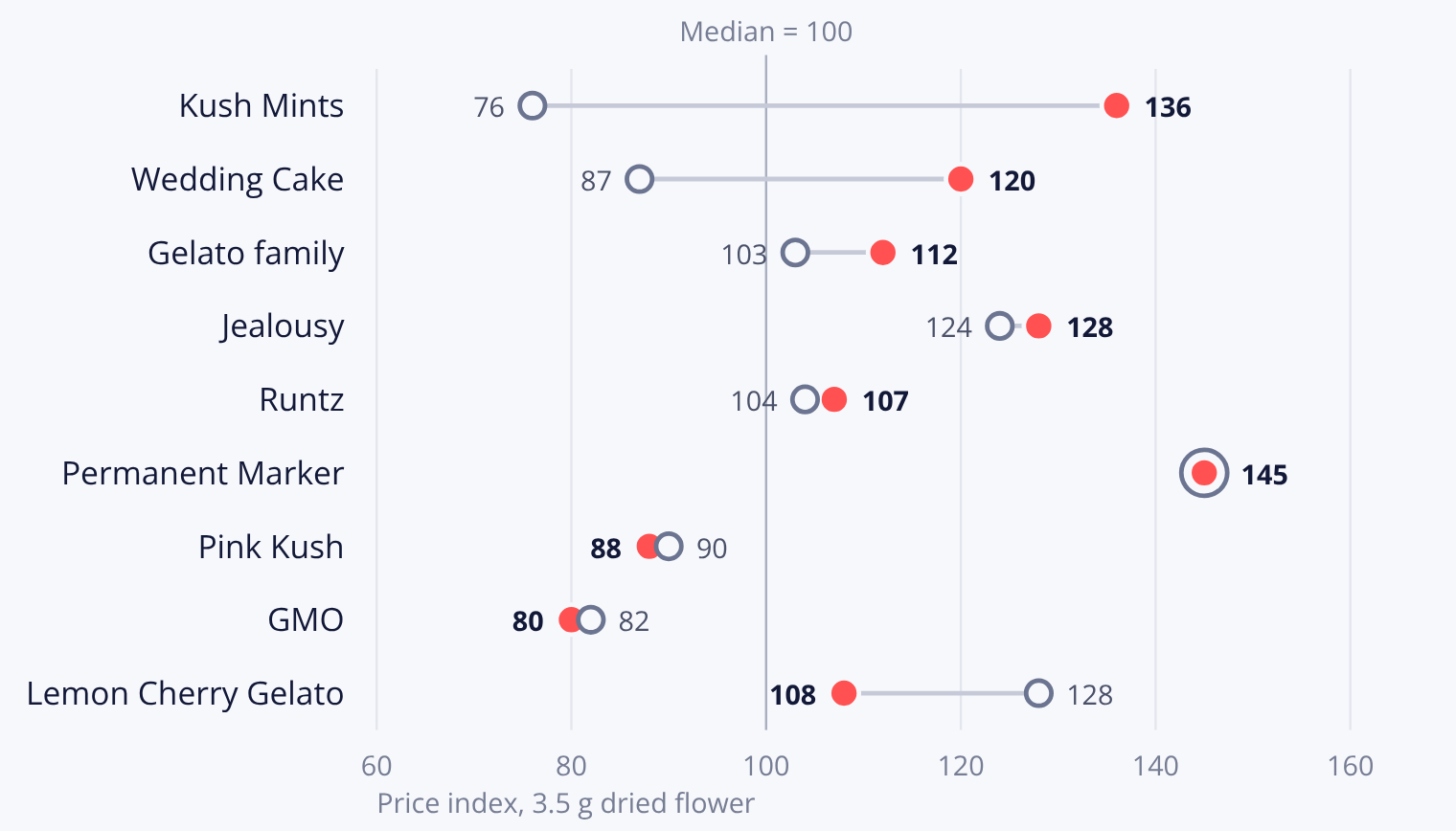
Price tells the same story from the other side. Across Canadian stores over the last four weeks, we compared the median shelf price of 3.5 g dried flower for each group against the median for all 3.5 g flower.
Kush Mints and Wedding Cake sell at value prices under their own name, and at a premium as crosses
Median shelf price of 3.5 g dried flower vs all 3.5 g flower in Canada (= 100), August 28 to September 24, 2026.
Show the data as a table
| Name | Under the name | Through crosses |
|---|---|---|
| Kush Mints | 76 | 136 |
| Wedding Cake | 87 | 120 |
| Gelato family | 103 | 112 |
| Jealousy | 124 | 128 |
| Runtz | 104 | 107 |
| Permanent Marker | 145 | 145 |
| Pink Kush | 90 | 88 |
| GMO | 82 | 80 |
| Lemon Cherry Gelato | 128 | 108 |
Kush Mints is the clearest case: labelled Kush Mints now sits a quarter below the median 3.5 g, while crosses bred from it sell at a 36% premium. Wedding Cake shows the same split. Names that are still early, like Permanent Marker, sell at a premium of 40% or more, and Lemon Cherry Gelato, with only three brands on the label, still holds its premium under its own name.
Finding 4: Evergreens are still the floor
The classics still outsell the hype. Counting both labels and lineage, Pink Kush and GMO each hold a bigger share of Ontario sales than any hype name we tracked, including the whole Gelato family, and each sold in 1,600 to 1,800 stores across ten or more provinces last month. GMO crosses grew their share by about a third in two years. Hype is where brands compete for attention. Evergreens are where most of the volume still sits.
Québec: where hype needs a shelf
Québec makes a useful comparison because one buyer, the SQDC, selects the assortment for the whole province. That changes how hype behaves.
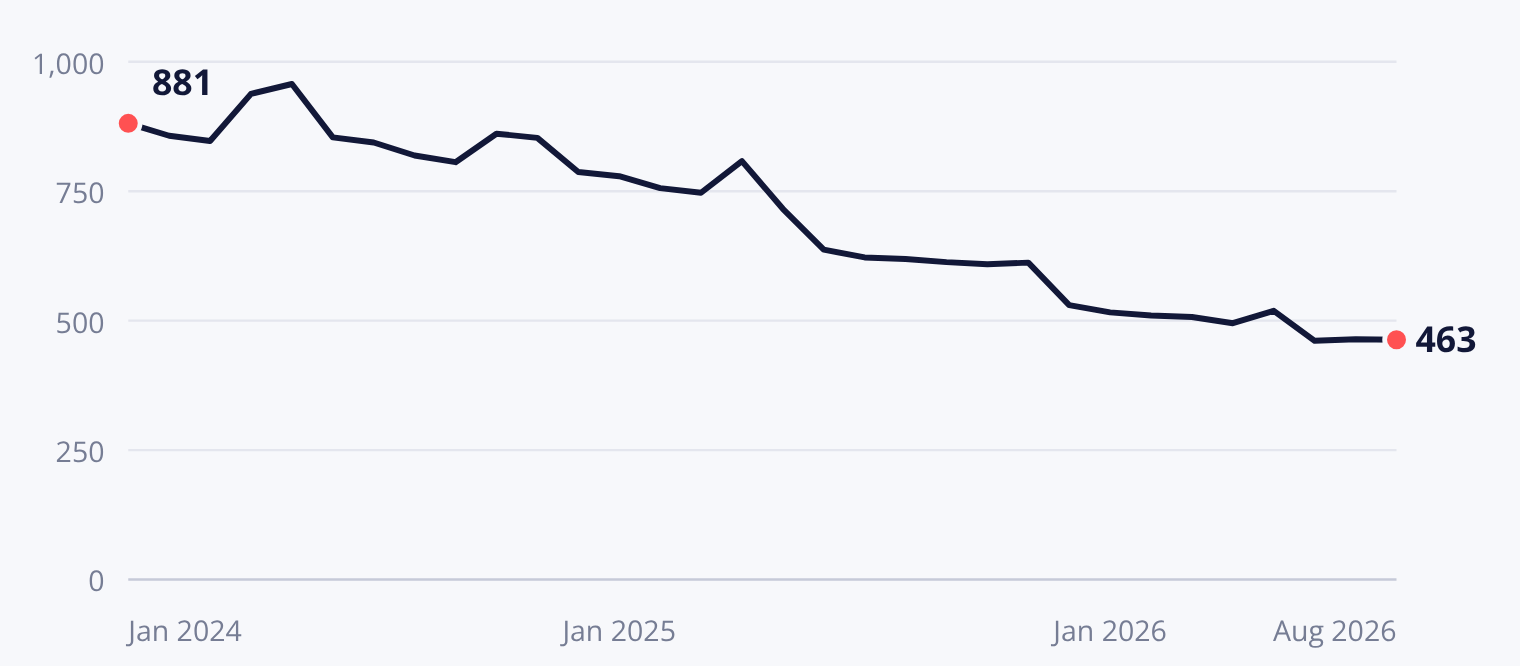
The SQDC range has become more focused: about half as many products sell each month as in early 2024
Distinct products with at least one sale in the month, all SQDC stores. The number of stores grew from 99 to 115 over the same period.
Show the data as a table
| Month | Products selling |
|---|---|
| Jan 2024 | 881 |
| Feb 2024 | 857 |
| Mar 2024 | 847 |
| Apr 2024 | 938 |
| May 2024 | 957 |
| Jun 2024 | 854 |
| Jul 2024 | 844 |
| Aug 2024 | 819 |
| Sep 2024 | 806 |
| Oct 2024 | 861 |
| Nov 2024 | 853 |
| Dec 2024 | 787 |
| Jan 2025 | 779 |
| Feb 2025 | 756 |
| Mar 2025 | 747 |
| Apr 2025 | 808 |
| May 2025 | 716 |
| Jun 2025 | 637 |
| Jul 2025 | 622 |
| Aug 2025 | 619 |
| Sep 2025 | 613 |
| Oct 2025 | 609 |
| Nov 2025 | 612 |
| Dec 2025 | 530 |
| Jan 2026 | 516 |
| Feb 2026 | 510 |
| Mar 2026 | 507 |
| Apr 2026 | 495 |
| May 2026 | 519 |
| Jun 2026 | 461 |
| Jul 2026 | 464 |
| Aug 2026 | 463 |
Over the last four weeks, about 490 products sold in Québec, compared with about 8,800 in Ontario. With fewer slots, most of the names that circulate in Ontario never reach the shelf. Lemon Cherry Gelato and Zushi have not appeared at all. Kush Mints and Gary Payton show up as a single product each. GMO went from five brands in 2024 to one. Runtz went from seven brands to four, and Pink Kush’s share of sales fell by more than a third.
The exception is the Gelato family. Its share of Québec sales has stayed between roughly 3.5% and 4% for three years, higher than in Ontario, spread across nine brands. It is the one hype lineage broad enough to earn several of a limited number of listings.
For brands, the lesson is the same as in Ontario, only sharper: in a curated market you are not competing to ride a name, you are competing for one of a few hundred places on the shelf. A cross with a clear story and a proven parent travels further than a borrowed name.
What this means for marketers
- Don’t build the campaign around a name you don’t own. A famous strain name brings attention to the category, not to your SKU. Brands that bred the genetics into their own named cultivar held both reach and price.
- Watch brand count as a warning, not a green light. When the number of producers using a name is climbing fast, the window to launch into it is usually closing.
- Price is the tell. If labelled versions of a name are sliding toward value pricing on shelf, the hype has become a commodity. That is the moment to talk about lineage, terpenes and grower story rather than the name.
- Keep an evergreen in the lineup. The classics are unglamorous and they keep selling.
About the data
Share-of-sales trends come from Ontario Cannabis Store monthly wholesale sales to stores, reported here only as shares and relative changes, all categories except accessories, comparing March to August of each year. Shelf coverage and prices come from Weed Crawler, which tracks the public menus and inventory of cannabis stores across Canada every day. Store counts are stores where the product was observed selling between August 28 and September 24, 2026. Québec trends come from the same daily tracking of SQDC stores since 2024. “Lineage” relies on producers publishing parent strains, which about 43% of products do, so lineage figures are a floor. Only names carried by at least three brands are reported.
Last Updated on October 15, 2026 by Chris De Sa


